Substation Control Room
This is an AI-generated summary of “Substation Control Room” — a 7 min YouTube video by rozhbin_electric, published January 23, 2022. It condenses the full transcript into 9 key takeaways with clickable timestamps.
Summary
This video provides a detailed tour of a high voltage substation control room, introducing and explaining the functions of various panel boards, including those for control, protection, measurement, SCADA, and power supply systems.
Key Points
- The video offers an introduction to a 230 kV high voltage substation control room, highlighting the almost identical panel board configurations across different substations.
- The control room features distinct control panel boards for both the 230 kV and 33 kV lines, managing incoming, outgoing, and coupling bays.
- Protection panel boards, installed behind the control panels, utilize Siemens relays such as differential, distance, and current relays to ensure substation safety.
- The measurement panel board (Q) is dedicated to power metering, while the interface panel board (UB) serves as the entry point for all signals from the substation area.
- The SCADA panel board (YV) receives signals from the interface panel and forwards them to the RTU panel board for transmission to dispatching.
- Specialized panels include the AVR panel for line bays, the Fault Recorder (FR) for documenting faults, and the Event Recorder (ER) for logging all substation occurrences and status changes.
- The RTU (Remote Terminal Unit) panel board is responsible for collecting all signals from SCADA and sending them to the central dispatching system.
- The battery charger panel board supplies DC power to command circuits, while the UPS panel board provides an uninterruptible power output for critical systems.
- The substation internal consumption panel board manages the power supply for the substation's own operational needs, drawing from auxiliary transformers.
Summarize any YouTube video, free
You just read an AI summary of this video. Paste any other YouTube link and get the key points with clickable timestamps in seconds — no signup, 5 free a day.
More Resources
More Summaries
 23 min
Stalin Built a Subway Beneath the Kremlin — Then Shot Every Worker Who Could Find the Entrance
The video details the construction, purpose, and eventual fate of Metro 2 (D6), a secret deep-underground railway built by Stalin to evacuate Soviet leadership during a nuclear war, highlighting the e
 27 min
30 Day Yoga for Weight Loss Julia Marie 🔥 Awaken Your Inner Warrior, Beginners 25 Min Workout, Day 2
This video, part of a 30-day yoga for weight loss program, focuses on "awakening your inner warrior" through poses that stimulate calorie-torching leg and glute muscles, build confidence, and improve
 21 min
Why was Stalin obsessed with trains?
This video explores the contrasting aesthetics of Soviet Metro stations, revealing how the lavish grandeur of Moscow's stations under Stalin was built on hypocrisy, forced labor, and imperial exploita
 17 min
Money Is Infinite—So Why Are People Still Poor? | Prof. Jiang Xueqin
This video traces the evolution of money from gold receipts to central banking, arguing that money is an infinite resource whose artificial scarcity, maintained through poverty, crises, and wars, is a
 2 hr 27 min
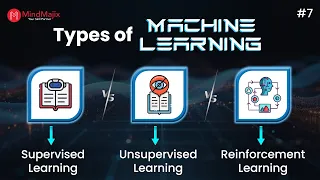
Types of Machine Learning With Examples | Supervised, Unsupervised & Reinforcement Explained (2026)
This module provides an in-depth exploration of machine learning types, primarily focusing on supervised learning algorithms such as linear, multiple linear, polynomial, and logistic regression, along