How I trained my mind to create instead of consume
By Josh Czuba
This is an AI-generated summary of “How I trained my mind to create instead of consume” — a 15 min YouTube video by Josh Czuba, published February 3, 2026. It condenses the full transcript into 9 key takeaways with clickable timestamps.
Summary
The video urges viewers to break free from addictive technology by de‑stimulating, rediscovering curiosity, and committing to purposeful, creative work to reclaim their humanity and impact the world.
Key Points
- Technology and constant digital stimulation are making people less focused and more disengaged from deep thinking.
- By engaging in creative or purposeful work, individuals not only improve themselves but also contribute to a healthier collective consciousness.
- The speaker emphasizes taking responsibility for one’s time, habits, and attention instead of abandoning technology entirely.
- The first step is to de‑stimulate: rest, reduce screen time, get sleep, hydrate, and eat low‑stimulation foods to reset the brain.
- Consistently practice small, disciplined actions—like waking up on time, walking, and writing—to build momentum and resist distraction.
- After de‑stimulation, identify intrinsic motivations and try activities you genuinely enjoy without fearing perfection or external validation.
- Embrace discomfort and challenge as part of the learning process; repeated exposure makes the struggle rewarding and habit‑forming.
- Turn the pursuit of meaningful, difficult work into a healthy “drug” that fuels creativity rather than seeking cheap dopamine hits.
- The speaker frames this personal transformation as a way to counter a dystopian future and ultimately “save the world” through individual growth.
Summarize any YouTube video, free
You just read an AI summary of this video. Paste any other YouTube link and get the key points with clickable timestamps in seconds — no signup, 5 free a day.
More Resources
More Summaries
 4 min
In 4 minutes I'll make you stop consuming, and start creating
The video explains how resistance keeps creators stuck in endless consumption and planning, and urges taking small, imperfect actions to break the cycle and build confidence.
 11 min
how to switch from watching to creating.
The video encourages creators to overcome hesitation by starting now, learning from heroes, embracing limitations, and staying consistent to develop their unique voice.
 37 min
Yann LeCun's $1B Bet Against LLMs [Part 1]
The video explains Yann LeCun's JEPA framework and the evolution of joint‑embedding self‑supervised vision models, showing how they avoid generative pixel prediction, achieve near‑supervised accuracy,
 13 min
Is This the END of LLMs? NCM Could Change Everything
An unemployed ex-big tech software engineer introduces and explains Next Concept Modeling (NCM), a novel AI architecture developed at Stanford University, which offers potential orders of magnitude im
 20 min
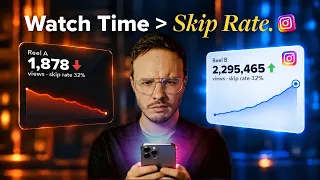
How to Force the Instagram Algorithm to Push Your Reels (based on data)
To break out on Instagram in 2026-2027, focus on holding viewer attention past the initial 5-10 seconds, achieve a good skip rate relative to your niche and past performance, and ensure content contex