Learn Every ICT Concept in 17 Minutes (Liquidity, FVG, Order Blocks & More)
This is an AI-generated summary of “Learn Every ICT Concept in 17 Minutes (Liquidity, FVG, Order Blocks & More)” — a 17 min YouTube video by Pro Trading School, published June 7, 2025. It condenses the full transcript into 9 key takeaways with clickable timestamps.
Summary
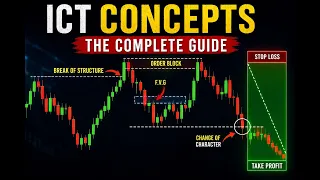
The video breaks down core ICT smart‑money concepts—liquidity, fair value gaps, the power of three, and order blocks—showing how institutions manipulate price and how traders can identify and trade these patterns.
Key Points
- Liquidity zones are areas with clustered stop orders that smart money targets to trigger retail stops and collect liquidity.
- Buyside liquidity consists of buy‑stop orders placed above recent highs, while sellside liquidity consists of sell‑stop orders placed below recent lows, and institutions push price to capture these stops before reversing.
- Liquidity traps occur when price briefly breaks a support or resistance level to trigger stops, then reverses, allowing smart money to clear the liquidity before the real move.
- A fair value gap is an unfilled price imbalance created by a strong middle candle between two smaller candles, and it acts as a magnet for price retests.
- To trade fair value gaps effectively, use only unmitigated gaps, prioritize larger gaps, avoid gaps near major support or resistance, and look for gaps that form right after a break of structure.
- The power of three pattern divides price action into consolidation, manipulation (a false breakout that sweeps liquidity), and acceleration phases, guiding entry timing.
- In bullish power of three, enter on the candle that closes back inside the range after a false breakout above resistance, placing stop above the breakout high and targeting the next support.
- In bearish power of three, enter on the candle that closes back inside the range after a false breakdown below support, placing stop below the breakout low and targeting the next resistance.
- Order blocks are zones where institutions placed large buy or sell orders, identified by an imbalance gap, must be unmitigated, and require a break of structure to confirm their validity.
Summarize any YouTube video, free
You just read an AI summary of this video. Paste any other YouTube link and get the key points with clickable timestamps in seconds — no signup, 5 free a day.
More Resources
More Summaries
 20 min
Learn ICT Concepts in 20 Minutes (Liquidity Sweeps& Order Blocks)
This video explains and demonstrates key Inner Circle Trader (ICT) concepts like liquidity sweeps, breaks of structure, changes of character, fair value gaps, and order blocks, providing practical cha
 12 min
Communal Discernment | Dr Pavulraj Michael SJ | Ignatian Discernment Series-03 |#loyolatvmadurai
This video explains the concept and a 10-step process for 'discernment in common,' a method for groups to make decisions prayerfully and collaboratively, rooted in Ignatian tradition.
 48 min
The Two Ways Governments Fail
This video explores the challenges faced by government agencies like FEMA in maintaining public trust and operational effectiveness amidst a media landscape that prioritizes sensationalism and algorit
 20 min
How to Reprogram Your Subconscious Mind in One Emotion
The video explains that your personal frequency—shaped by inner thoughts, emotions, and self‑concept—precedes and determines how others perceive and respond to you, and offers techniques to consciousl
 44 min
6 Figures And Still Struggling" — The Truth About Money In Canada
The interview explores Zwenga’s journey from a successful career in Nigeria to immigrating to Canada, highlighting the financial, cultural, and personal challenges he faced and the practical lessons h