Foundation of Computing AI, Python @ Math -Day1
By Indore Institute of Science and Technology IIST
This is an AI-generated summary of “Foundation of Computing AI, Python @ Math -Day1” — a 3 hr 39 min YouTube video by Indore Institute of Science and Technology IIST, published August 23, 2026. It condenses the full transcript into 8 key takeaways with clickable timestamps.
Summary
This video offers an introductory session covering the fundamental concepts of software categories, the binary language and its conversion, and essential engineering mathematics topics like algebra, calculus, vectors, and matrices, highlighting their practical applications and the pervasive role of AI and Python in modern technology.
Key Points
- The session provides a foundational understanding of software and engineering mathematics, applicable to all engineering disciplines, including CS, IT, AI/ML, Data Science, Mechanical, Civil, and EC.
- Computers fundamentally operate on binary language (0s and 1s), explained through memory units and current flow, with practical methods for decimal-to-binary conversion.
- Python is emphasized as a highly versatile and easy-to-learn programming language, indispensable for AI, Machine Learning, and Data Science due to its extensive libraries and ability to integrate AI across diverse software applications.
- Software is broadly classified into four categories: System Software (OS components like loaders, compilers, primarily built with C/C++), Application Software (on-demand, specific-purpose, utilizing front-end and back-end databases with SQL), Web Applications (internet-dependent, browser-based, using HTML, PHP, Java, ASP.NET), and Device/Mobile Applications (for movable devices, using J2ME, Kotlin, Flutter).
- The mathematics segment introduces basic algebra, covering algebraic expressions, variables, constants, coefficients, and fundamental properties of real numbers (closure, commutative, associative, identity).
- Essential algebraic techniques like factorization (by common terms, grouping, identities, and splitting the middle term) and the classification of polynomials (linear, quadratic) are explained.
- Methods for solving quadratic equations, including factorization and the quadratic formula, are demonstrated, along with determining the nature of their roots using the discriminant (b²-4ac).
- The session concludes with the relationships between roots and coefficients of a quadratic equation (sum and product of roots) and how to construct a quadratic equation from its given roots.
Summarize any YouTube video, free
You just read an AI summary of this video. Paste any other YouTube link and get the key points with clickable timestamps in seconds — no signup, 5 free a day.
More Resources
More Summaries
 19 min
I'm Changing How I Invest My Money Because of AI
The speaker, a seasoned investor, explains how the potential AI bubble and over-concentration of investments in a few AI-driven companies within the S&P 500 have compelled him to diversify his long-st
 21 min
How To Become Dangerously Self-Educated With AI (for free)
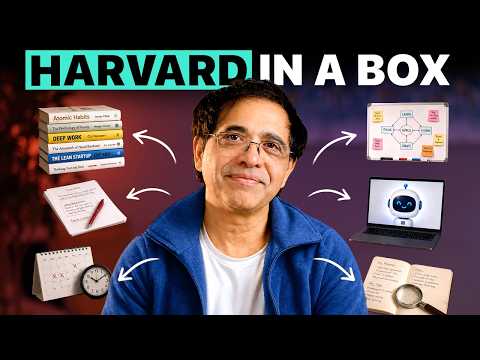
This video introduces a five-step AI-powered learning system called the 'University in a Box' that leverages AI as an advisor, librarian, tutor, editor, and roommate to enable anyone to become a self-
 4 hr 6 min
Candace Owens vs. Andrew Wilson: The Charlie Kirk Debate | PBD Podcast
The debate centered on Andrew Wilson's claim of overwhelming evidence that Tyler Robinson murdered Charlie Kirk, which Candace Owens countered by asserting Robinson was a patsy and the state's case wa
 16 min
Copernicus and the Scientific Revolution
The video chronicles humanity's astronomical journey from ancient geocentric views to the modern understanding of an expanding universe, showcasing the revolutionary contributions of scientists like C
 28 min
I wasted 33 years trapped in my own head before Anthony Bourdain explained this in 30 minutes…
Anthony Bourdain's legacy is defined by his fearless pursuit of authenticity, creative freedom, and a profound curiosity that challenged conventional storytelling and broadened perspectives on food, c