Forget the imaginary, just attend to what is || Acharya Prashant (2014)
This is an AI-generated summary of “Forget the imaginary, just attend to what is || Acharya Prashant (2014)” — a 11 min YouTube video by Acharya Prashant, published August 17, 2019. It condenses the full transcript into 9 key takeaways with clickable timestamps.
Summary
The video argues that humanity's obsession with understanding death stems from fear and a confused mind, suggesting that true understanding of death comes from fully engaging with and clarifying one's perception of life's present moments.
Key Points
- The speaker urges listeners to shift their focus from imaginary future events like death to the immediate realities and details of the present moment.
- The speaker uses the analogy of a "mirror" (the mind) that must be cleaned and polished; only a clear mind can perceive everything, including death, as it truly is.
- It asserts that the same confused and unclear mind that seeks to understand death is also incapable of understanding daily life, relationships, and personal experiences.
- Obsession with death, often driven by the fear of annihilation, prevents individuals from genuinely understanding and engaging with the present moment of life.
- The video challenges the common human obsession with death, questioning why it is deemed more important than the countless moments of life, attributing this focus to fear.
- A mind that demonstrates incapability or confusion in one area of life will inevitably exhibit the same limitations in all other areas, as it is the same fundamental mind at play.
- Spontaneity and proper timing are presented as essential skills for navigating all aspects of life, from physical activities to social interactions, stemming from a mind free from possession or confusion.
- By paying close attention to and understanding the specifics of one's current life—such as daily tasks, interactions, and surroundings—one will naturally gain an understanding of death without needing direct instruction.
- The ancient story of Nachiketa and Yamraj is referenced to illustrate that true understanding of death comes through a profound understanding of life itself, not through direct answers about death.
Summarize any YouTube video, free
You just read an AI summary of this video. Paste any other YouTube link and get the key points with clickable timestamps in seconds — no signup, 5 free a day.
More Resources
More Summaries
 1 hr 11 min
Jean-Pierre Garnier Malet en el Observatoire du Réel. Esas Verdades Escondidas (EN FRANCÉS)
The speaker presents a controversial “doubling of time” theory linking ancient calendars, quantum physics, and spiritual cycles, claiming humanity is poised for a transformative era driven by hidden g
 6 min
6 minGlobal Warming - The End Game | The Dr. Binocs Show | Best Learning Videos For Kids | Peekaboo Kidz
Global warming is the significant rise in Earth's average temperature due to human activities like burning fossil fuels and deforestation, leading to severe environmental consequences, but individual
 26 min
MAKE MANIFESTATION SIMPLE AGAIN PART 473
The video teaches how to manifest your desired reality by aligning your self-perception, thoughts, and internal dialogue with the version of yourself that already possesses what you seek, emphasizing
 1 min
1 minEverything in Fortnitemares in 60 Seconds...
The video provides a speculative overview of Fort Nightmares 2026 in Fortnite, detailing numerous new collaborations, sprites, items, map changes, and boss encounters.
 7 min
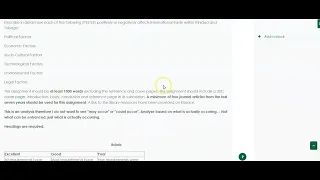
7 minExplanation video for Assignment #2 PESTLE - MGMT365
This video explains the requirements for an international business assignment focused on analyzing the PESTEL factors (Political, Economic, Sociocultural, Technological, Environmental, Legal) and thei