Lecture 09: Exact BER Expression for Rayleigh Fading Wireless Channel
This is an AI-generated summary of “Lecture 09: Exact BER Expression for Rayleigh Fading Wireless Channel” — a 19 min YouTube video by NOC15 July-Sep EC05, published July 8, 2015. It condenses the full transcript into 9 key takeaways with clickable timestamps.
Summary
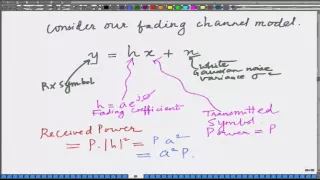
This module provides a detailed derivation and evaluation of the exact bit error rate (BER) expression for a wireless communication system, specifically for BPSK modulation in a Rayleigh fading channel.
Key Points
- The average BER is initially represented as an integral involving the Q function, the signal-to-noise ratio (SNR), and the Rayleigh density function of the fading channel amplitude.
- The module's primary objective is to derive and evaluate the exact bit error rate (BER) expression for a wireless communication system.
- The derivation begins by substituting SNR with 'mu' and replacing the Q function with its integral definition, resulting in a double integral.
- To simplify the calculation, the order of integration for the double integral is reversed, allowing the inner integral with respect to 'a' to be evaluated first.
- The inner integral is solved by comparing it to a known result for the variance of a Gaussian distribution, leading to a simplified expression in terms of 'mu' and 'u'.
- The outer integral, now simplified, is evaluated using a trigonometric substitution (u = square root of 2/mu tan(theta)), which transforms the integral limits and integrand.
- After simplification and integration of the trigonometric expression, the result is expressed in terms of sine of an inverse tangent function.
- A trigonometric identity is applied to simplify the sine of the inverse tangent term, leading to an expression involving the square root of mu and (2 + mu).
- Finally, substituting 'mu' back with SNR, the exact average bit error rate for BPSK transmission in a Rayleigh fading channel is derived as half times (1 minus square root of SNR divided by (2 plus SNR)).
Summarize any YouTube video, free
You just read an AI summary of this video. Paste any other YouTube link and get the key points with clickable timestamps in seconds — no signup, 5 free a day.
More Resources
More Summaries
 22 min
Lecture 10: Deep Fade Analysis of Wireless Communication
This module intuitively explains that the poor bit error rate performance of wireless communication systems, compared to wireline systems, is primarily caused by deep fade events in the fading wireles
 1 hr 4 min
ISO 42001 Basics: What It Is and How to Get Certified Fast
This webinar provides a comprehensive overview of ISO 42001, an emerging international standard for AI risk management, detailing its business case, framework structure, implementation process, certif
 16 min
Отпусти ситуацию и она разрешится: простой принцип изменить свою жизнь — Вадим Зеланд
Ivan built Lancer, an AI agent that automates Upwork job discovery and bidding, achieving $10,000 MRR within months by leveraging a unique "connector" growth strategy instead of paid ads.
 1 hr 20 min
AZ ORBÁN-RENDSZER 16 ÉVE, 1.rész: a gazdaságról Surányi György, közgazdász-professzor /// F.P. 139.
This video, featuring economist György Surányi, critically analyzes the Orbán regime's 16 years of economic policy in Hungary, concluding that its focus on political loyalty and individual profit-seek
 1 hr 38 min
The Higher Mind — How the Universal Mind Sends You Intuition - Jospeh Murphy
This video, based on Joseph Murphy's teachings, offers a rational and methodical guide to accessing the "higher mind" and "infinite intelligence" through practices like deep meditation, intuition deve