ALL of Edexcel IGCSE Chemistry 9-1 | PAPER 1 / DOUBLE AWARD 2025 | IGCSE Chemistry Revision
This is an AI-generated summary of “ALL of Edexcel IGCSE Chemistry 9-1 | PAPER 1 / DOUBLE AWARD 2025 | IGCSE Chemistry Revision” — a 1 hr 48 min YouTube video by Science with Hazel, published December 22, 2018. It condenses the full transcript into 10 key takeaways with clickable timestamps.
Summary
This comprehensive video provides an all-in-one IGCSE Edexcel Chemistry revision, covering fundamental concepts, atomic structure, chemical bonding, calculations, reactivity, and organic chemistry.
Key Points
- The video begins by explaining the states of matter (solids, liquids, gases), their particle arrangements, kinetic energy, and the processes of melting, freezing, boiling, condensation, evaporation, and diffusion.
- It defines fundamental chemical terms such as atom, element, mixture, compound, pure substance, solute, solvent, solution, and saturated solution, along with various separation techniques like filtration, distillation, and chromatography.
- The structure of an atom, including protons, neutrons, and electrons, is covered, along with electronic configuration, mass and atomic numbers, isotopes, and how to interpret the periodic table's groups and periods.
- Key quantitative chemistry calculations are demonstrated, including balancing equations, determining relative formula mass, calculating moles, finding empirical and molecular formulas, and calculating percentage yield.
- Chemical bonding is explained through ionic bonding (electron transfer between metals and nonmetals) and covalent bonding (electron sharing between nonmetals), with examples and diagrams.
- The properties of giant ionic, giant covalent (diamond, graphite, fullerene), and simple molecular structures are discussed in relation to their bonding and intermolecular forces, explaining their melting points and conductivity.
- The reactivity series of metals is presented, along with methods to determine reactivity, ways to prevent rusting (e.g., galvanizing), and definitions of oxidation and reduction.
- Acids, bases, and salts are defined, common reactions to form salts are outlined, and solubility rules for various salts are provided, alongside an introduction to the Brønsted-Lowry theory.
- Organic chemistry introduces hydrocarbons, alkanes, and alkenes, their general formulas, isomerism, functional groups, and the processes of fractional distillation of crude oil, combustion, cracking, and polymerization.
- The video concludes by discussing environmental issues related to combustion, such as acid rain and the problems associated with the disposal of addition polymers.
Summarize any YouTube video, free
You just read an AI summary of this video. Paste any other YouTube link and get the key points with clickable timestamps in seconds — no signup, 5 free a day.
More Resources
More Summaries
 20 min
ТЕХНИКА ДВА БЛОКНОТА, КОТОРАЯ МЕНЯЕТ ЖИЗНЬ ЗА 7 ДНЕЙ | КАК ПЕРЕПРОГРАММИРОВАТЬ СЕБЯ - ТРАНСЕРФИНГ
The video introduces the "Two Notebooks" technique from Transurfing Reality, a practice designed to help individuals process their past, present, and future by separating old emotional baggage from ne
 1 hr 2 min
Why I Have Always Pushed Brand Over Digital Sales | Inside 4Ds
This video features a discussion with Gary Vaynerchuk and other entrepreneurs about building brands, leveraging social media platforms like TikTok, the importance of mascots, and navigating the evolvi
 7 min
7 minAI Document Processing: Automate 90% of Your Business Workflow
This video explains how AI-powered document processing, specifically Doc sumo's five-step workflow, can significantly reduce manual data entry hours, boost accuracy, and provide valuable insights for
 20 min
165.Innervation of Larynx #nerve supply of larynx and pharynx #larynx #sensory
The vagus nerve (cranial nerve X) innervates the larynx through its superior and recurrent laryngeal branches, providing both motor and sensory functions crucial for voice and breathing.
 3 min
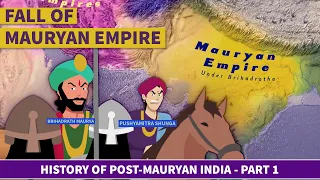
3 minFall of Mauryan Empire and the Beginning of The Post-Mauryan Era | Episode 1 History of India
This video provides an overview of the Post-Mauryan Period, detailing the assassination of Emperor Brihadrath by Pushyamitra Shunga, the subsequent fall of the Mauryan Empire, the rise of new dynastie